Preamble

When word got around that I was retiring from ILM a number of folks said I should write a book because I have so many stories. I started to get notes together of the 163 projects I worked on over the years at ILM and realized it was going to take a while and by the time I finished I’m not sure anyone would remember who I was. So I’ve decided to just make it a blog so I could start feeding out the memories in smaller chunks.
One of my problems in retirement is that I don’t have anyone from Production to tell me what to do each day so I’ve been a bit lax getting this going. My intent now is to post at least one thing a week. Not all the projects have interesting stories so you aren’t looking at 3 plus years to get this done. When we were working on “The Doors” movie, Robby Krieger (the Doors’ guitarist) was around a bit. The movie was pretty Jim Morrison centric and at some point Michael Owens (the VFX Supe for the movie) asked Robby if it bothered him that they weren’t telling more of the story of the other band members. He very graciously responded “ The Doors had a lot of stories. This one is just Jim’s.” In that spirit I’m not putting this out there as a definitive history of ILM, just odds and ends of my stories for my friends, not a complete diary of my time there I’m grabbing images from where I can to help tell the story.
I could go down a technical rabbit hole with a lot of the work I did because of my role but I will try to keep those discussions at an “Executive Level”. That was what was requested when we used to put together presentations for the Board meetings George used to have to explain both the artistic and technical details of what we were working on. The Board members were business folks that George chose to help him make decisions about the company not nerds or artists, so we’d need to dumb down the explanations so their eyes wouldn’t glaze over. For example in 1987 I was asked to come up with some notes about the MC Optical Printer which was a big technical deal at the time.
I might have said, “Regarding its repeatability of camera motion control movements. It was accurate to .0001 of an inch due to the precise integration of the drivers of the stepper motors and the physical perfection of the various linear accelerators mounted on the stationary base with a proper mix of alloys and the integrated spreadsheet software that drove the motors. This allows us to do repeatable moving passes as we construct the final composite images you see on the screen.”
But none of that would have made sense to them.
So the “Executive Level” note I sent along was
-
Normally Optical Printers don’t move.
-
This one does which allows for expanded creative concepts and technical fixes.
-
It is accurate to .0001 of an inch. To put that in perspective, if I threw a baseball with the same accuracy from here in SF I could hit the Empire State Building in NYC. Then if I threw another one I would hit it again in the same place.”
I am going to start now when I walked in the door at ILM. If you want to see how I got to ILM go to the About section where I have a somewhat edited version of my life up to this point. I'm not going to go in chronological order after this start, just in the order stories come back to me but I will include the years each took place so you can make some sense of it.
Getting a foot in the door
“Howard the Duck” production was not going well when I got a call from Rob Burton asking if I’d be interested in coming to ILM to work as a Tondreau system motion control operator.
(There is an explanation of Bill Tondreau in the ABOUT/Calico section)
The job I was working in Washington D.C. was a bit of a dead end so this was like asking if I wanted to go heaven. It was 1986 and ILM had a good reputation but hadn’t done a ton of movies yet and was located just outside San Francisco. The area had some film production but not nearly as much as Los Angeles. New York hadn’t turned out to be a great backup to working on films in Washington D.C. that I had hoped for. San Francisco seemed a good option with LA as a backup that wasn’t all that far away.
Rob helped set up a job interview with Ellen Lichtwardt who was head of the overall Animation Department which included roto and the animation cameras.
Ellen is an incredible artist but not a camera operator so our interview leaned more into her finding out if she thought I would fit into their culture. ILM already had a bunch of incredible artists so as they expanded they certainly looked for more incredible artists but if the great artist turned out to be a jerk they would rather hire someone that fit in and could be trained up.
ILM was upgrading to Bill Tondreau’s camera motion control systems. When they asked Bill who was the best operator of his systems which were mainly in LA, he said Rob Burton. ILM hired him some months before me. When they asked again Rob & Bill suggested me so I just had to convince Ellen I wasn’t a jerk.
It was the 80’s and a different world than today. It was unusual to have women in charge of a department and it was still culturally not particularly acceptable to be gay in much of the United States. Neither of those things seemed to matter at ILM. They were just looking for good artists. I honestly don’t recall all the questions she asked but she was a good interviewer and oddly enough she made me feel pretty good about myself. She kind of pumped me up, getting me excited to join the team. She finally asked if I had any other questions. I didn’t and asked if she did. She said “Yes, how soon can you get here? I can only promise you 3 months but there looks like there will be projects right after this one, so it could be longer.” ( I ended up leaving 38 years and 7 months later.)
Laura and I made some quick arrangements, I hoped in a car and drove from Annapolis, MD to San Rafael, CA. Rob was kind enough to let me crash at his apartment till I could make other arrangements. On April 10, 1986 I drove up to ILM D Building at 3160 Kerner Blvd and knocked on the back door where Rob had told me the Animation department was. Jack Mongovan opened the door and let me in. (When ILM moved from Kerner to LDAC I made a point of going out this same door on my last day at Kerner and Jack was kind enough to lock it behind me and yell “And don’t come back!”)


Jack held this over my head for the rest of our working life together. Anytime he needed something he would say, “You owe me. Without me you’d never have gotten your foot in the door.” Jack was one of the best roto/painters ever. He transitioned from the film world to CG seamlessly. We shared an office on and off over the years. He was one of the funniest people I ever met and had such a kind heart. He was gay when it still wasn’t “okay” to be gay in a good part of the U.S. I do think his example helped any number of other folks at work come out of the closet back then. Being gay just wasn’t an issue at ILM and it is always easier to do tough work in a safe space. When the AIDs crisis hit he showed such courage and compassion. Jack would give a hug and sit with friends who were on their death bed because of AIDs. Jack never made a thing of doing this, he just did it. Sadly Jack died in 2014.
Ellen was a great department head and wonderful first ILM boss to me. There was a ton of stuff to do and everyone was pretty young but somehow it was all well organized and I don’t recall anyone ever yelling at anyone. (Well other than Willard Huyck (the director) and Gloria Katz (the producer) yelling at each other. But they were also married so it kind of went with the territory.) Ellen was a hoot and a had a big personality but as I mentioned she wasn’t a camera operator so she turned me over to Bruce Walters to get me settled in. Ellen was around a few more years then moved back to L.A. Some years after that, and I don’t know all the details. she and her son Eric had a company that had giant Tesla Coils that they could sync to music and bring them to whatever party you had. Here is a photo of one of their set ups at a Halloween Party at the Playboy Mansion. That should give you some idea of my first ILM boss. Yeah Toto, I wasn’t in Kansas anymore.

Bruce Walters showed me around. It was a quick introduction as I already knew everything I needed to know about running the animation stands. He really just showed me what rooms they were in, where the Prostar was to run my tests, where the moviolas were so I could view them, where to drop off my color film for processing at the end of the day and where to put my timecard. It was my understanding that I would be replacing Jay Riddle who was moving over to the new ILM CG department, which was still technically Pixar,to replace John Lassiter. John was kind of low man on the totem pole at Pixar because he didn't code so he was their "camera man" as well as doing that animation thing. Pixar had a "work in progress laser film recorder but it was slow. If they wanted to run out tests to see in the theater they would just use an old Mitchell Camera sitting on an apple box pointing towards a hi-res Evans & Sutherland monitor. That had been John's job.

I got to know John a bit because the camera folks were always bumping into each other and John had kids about the same age as mine so we had a bit of cross over there as well. John it turned out was a really good camera operator among other things. We heard in the hallway the George was selling Steve Jobs Pixar because of its potential for medical imaging.
Some months later when the Pixar deal was pretty much done and I had moved to the Optical Department I ran into John and asked him what he was going to do there since it didn't sound like animation was in Pixar's future. He said he didn't really know but they offered him a 1 year contract so he would see. I told him the Optical Department was looking for another camera operator and I could put in a good word for him if he wanted to stay with a bit of a more sure thing since he had kids and all. He said "Thanks but no thanks."
The lesson here is don't listen to me for career advice.
The photo is of the animation department. Jack is at the top of the stairs in a Fez. I’m to the left of him in a chef’s hat. Rob is to the right of me in a blue baseball cap and Ellen is just below us in a yellow top with a captain’s hat.

Howard the Duck : Slit scan
My first shot at ILM was one of Howard falling into Cleveland from space like a comet. This was back before there were CG particle systems so you needed to come up with either a practical effect on stage or some animation trick. “2001: A Space Odyssey” about 18 years earlier had created a number of slit scan effects that were done manually as far as triggering the various elements and camera as it was pre-computer driven motion control cameras. Since then folks, with the help of computer run motion control cameras, had come up with all sorts of variations on the slit scan scheme. (There is a ton of stuff online about slitscans if you want to go down that rabbit hole.)
For this shot the job was to make a comet like tail coming off Howard as he falls from space. It needed to have some movement like a smoke trail coming off him. The task was given to animation as it was cheaper to do it there than as a practical effect on stage. This is just a recreation of what I did. All those elements are locked away in some vault under some mountain in the Sierra’s waiting for future archeologists to ask “What the hell were they thinking.” This is how I did the slit scan effect
This was the original plate

This is the “slotgag”. A little slit that is dragged across some artwork as the camera moves. This exposes the film in a particular pattern like a comet tail. The arrow just indicates the direction of travel the slotgag moves as the camera slightly zooms out to give a little depth.

This is the noise pattern that is the artwork that the slotgag moves over. By animating this on each frame the noise pattern looks like it is moving as well.

This is a bit of roto to help shape the comet. This will help the slotgag expose the correct shape. This also moves with the comet.

This sphere is the head of the comet (Howard). I vaguely recall having a little Howard shaped bit of roto instead of just a sphere but I can’t see it in this lores version I grabbed from online.

This is a frame of the comp of that shot. Stunning! I know.

This is a clip with some of the surrounding shots which contain some tube shape slitscans as well.

This is a bit more obvious slit scan example (not in the film) just to help show the technique. There is the slotgag, a noise pattern and the result shooting through a blue filter while the camera zooms out and rotates.


Howard the Duck : Wire Removal
For me it was like being a bystander sitting in the lab the first time Thomas Edison hit the switch and a light bulb went on. Something big had just happened. In my case it was sitting in “Howard the Duck” dailies when I saw the first CG wire removal.
This was 1986 and I was an animation camera operator at ILM. In the opening scenes, Howard and his chair get pulled through the walls of the apartments next to his. This was done on a 1/4 scale practical set. Howard was a puppet and the chair had wires attached to it that would pull it through the walls. The wires were lit in such a way to minimize how visible they would be. Extra debris and smoke to hide the wires, shot as separate elements, would be added in the Optical composite. Because it was a practical set that gets destroyed there weren’t going to be extra takes to choose from.
The traditional way to do this in the film world, if the lighting didn’t make them disappear, was for mattes to be made for the offending areas and just blur those areas out in the optical composite so they weren’t so obvious taking advantage of the camera and stage props movement.
I have no way to show you the original frames. So I roughly recreated what one would have looked like.
On this frame on left side you can see the wires.

I was tasked with making mattes to chase around the wire wherever it showed up in frames. It was pretty thin but would show up more when the chair bounced as the wire’s motion blur would make it appear on film much thicker than it actually was. This is what the mattes for this frame would look like.

Optical would take this and make an inverse matte as well. That matte would expose all the frame except where the wires were. They would wind back the film and use this matte to expose the area where the wires were but throw them out of focus. This frame shows that.

If you didn’t know they were over there originally the hope was you wouldn’t notice the blurred out areas. This worked a lot of times especially if there was any bounce in the camera because of a lack of persistence of vision in your head. It didn’t work here. We tried lots of matte sizes and adding smoke and extra debris to try to cover it but it never was perfect. Granted it is subtle on one frame but was really obvious running at speed.
The Computer Graphics Division of Lucasfilm was evolving into Pixar which would eventually be sold to Steve Jobs. They had done the stained glass knight in 1985’s “Young Sherlock Holmes” but the software and hardware were really in their infant stage so weren’t practical for general production. That being said Mark Leather had authored a program called Layerpaint. Bruce Wallace used it to paint out the wires in the original plate. This was the result.
I can’t tell you how many times we looked at this shot on a loop and you just couldn’t see where the wires had been. I remember George Lucas sitting there in dailies and when he saw this he said, “Well everything in how we shoot films just changed.”

This sort of wire removal is now a pretty entry level cg job. There are a bunch of programs you can use on your home computer. At the time it really was like a seismic shift in visual effects production knowing you could perfectly hide flaws in original plates that used to take hours of crew time to try to set up on stage. I’m sure Thomas Edison would have been impressed. No one thinks of “Howard the Duck” as a CG game changer but it really was.
Leviathan 1988
Leviathan was a 1989 movie directed by George Cosmatos and produced by Luigi and Aurelio De Laurentiis. NOT Dino! Luigi and Aurelio were his older brother and his son (so Dino’s nephew). It was a flop. From what I was told Dino encouraged his older brother to follow in his footsteps and this was one of those efforts.
I bring this one up for two reasons. The first is that this has to have had the shortest production schedule of any film ILM got a credit for. It was about a day total and pretty much only me. I can’t recall all the pre-me details. This was all film no CG. Normally we would start with the original negative and then make an interpositive (IP) of that so we only touched the original bit of film once just in case something broke. Often original negative was irreplaceable with the faint hope there was an alternate take that was usable if you mucked it up.
From the IP we would then make a duplicate negative. Normally we would work off a duplicate negative (internegative) so if that got screwed up (which could happen just doing a lot of takes) we could strike a new one off the IP. But making a couple generations of color film took a couple of days because of the processing at a color lab. My point is that in the normal scheme of things shots took some time which we didn’t really have in this case. John Ellis, long time head of ILM Optical, used to say, “Optical can’t stop your film but we can sure slow it up.”
If you want to get a sense of Optical film compositing you can check out “The History of Composting” in the “VES Handbook of Visual Effects”. I wrote the article and I’m sure it is a total coincidence that the editors have it starting on page 666 (at least in the 2nd Edition).
We didn’t have time because we were in the middle of both “Who Framed Roger Rabbit” and “Willow”. Multiple shifts on the optical printers and working six days a week. As I recall I got an IP from the client to work off so we could deliver in one day.
I came in on Sunday (my theoretical day off) to do the work.
The shot was pretty simple. Stan Winston had made a scary looking fish model hanging from wires and it was meant to be coming quickly towards camera to scare a diver under water. The fish was scary enough looking but you could see the wires and the move was more languid than threatening. The production knew of ILM’s MC Printer, a motion controlled optical printer that could zoom (which was fairly rare in optical printers). My task was to take the IP and make an overriding move that looked scary and hide the wires then just give them the new negative. They had multiple takes so I worked on them all. Most of the takes were at least a couple seconds long. What ended up in the film was just 17 frames of my finest work from one of the takes. Check out this clip but don't blink.

For that ILM got this credit. The general consensus was De Laurentiis (Luigi not Dino) just wanted to get ILM’s name on his movie to give it a bit of industry street cred because nobody was as good as us at visual effects at that time.

I mentioned at the start I had two reasons for telling this story. The other has to do with the legendary Rose Duignan.

Rose started with Lucasfilm on the original “Star Wars” production. Over the years Rose came and went from ILM and this go round she was head of marketing. I don’t know that I ever heard how she came to be aware of what Luigi was up to but she saw it as a marketing opportunity especially with his brother Dino’s lean into visual effects movies. Somehow she got him to bring a shot to ILM. Rose knew how busy we all were but talked me into doing this as a favor to her on a Sunday. Rose is nothing if not persuasive. The problem was she didn’t have a budget in marketing to actually pay me for my time. BUT as Rose does she always finds a way. She knew my wife Laura and I had three little boys. Raising kids herself, she knew how valuable nights off from them can be. Her selling point was, although she couldn’t pay me, she could with her marketing budget, give my wife and I a night on the town. She suggested that Grandma watch the kids for the night and she would book us into a very fancy restaurant and then put us up for the night at the Westin St. Francis Hotel in San Francisco.
I got the shot done. The client was happy. My wife and I had a great night out on the town. . . . and then about 9 months later my son Drew was born. The lesson learned here was be very careful what Rose talks you into. There can be extreme hidden consequences. 18 years later I tried sending her a purchase order to cover Drew’s college tuition but she said she wasn’t at the company any longer.
Always 1989
I worked on “Always”, the movie starring Richard Dreyfus, & John Goodman as aerial firefighters. This movie was composited on optical printers on film. This was during the time frame when I was an Optical God running the MC Printer. (A bit later I switched departments and became a mere CG mortal).
ILM had created a massive practical 1/4 scale forest set in some old warehouse with tons of pyro and “flew” the airplane models through it filming with the camera mounted on the back of a truck which bounced along.
For the close ups of Dreyfus & Goodman there was a cockpit mounted on a gimbal that the grips could move so it looked like they were getting buffeted by the fire’s wind impact but they really couldn’t bounce it up and down just yaw, pitch and roll. The buffeting didn’t really match up too well in the cut and wasn’t as dramatic as real planes flying low through forest fires.
The MC Printer was basically a computer controlled machine tool with incredible repeatable precision. So in post I could add (match, smooth out) camera movement as I put the layers together. Joe Johnston was helping out running dailies ( I think Bruce Nicholson, the FX Supe, was on location). I made a whole series of variations on the buffeting going from not much to a whole bunch so Joe could decide what looked best. We were in “afternoonlies” in D Theatre. My work initially wasn’t impressing Joe and he politely passed on a number of takes. The mind is an interesting thing. If you see extreme motion sometimes your brain almost makes you feel it. As we got to some of my more enhanced takes, I swear I started to feel the haptics and my seat moving. I’d finally impressed Joe and he said pretty emphatically. “That’s the one! That looks great.” It was at this point I noticed those big speakers hanging from the ceiling to the left and right of the screen were swinging along with the room. Someone shouted out “Earthquake!!” and we all scrambled out into the parking lot. It was 5:04pm on Oct 17, 1989 when the Loma Prieta earthquake hit.
I remember seeing the side of D Building buckle out and back and the trees on that ridge between San Rafael & Corte Madera move like a wave. Fortunately D Theatre was unharmed and we all got out safely.
Adding this sort of movement is not a big deal to do in post today but at the time it was something. The scenes I worked on were pretty long in the final cut but here is a clip that shows the sort of movement I added. (Minus the earthquake)

Nightmare Before Christmas 1993
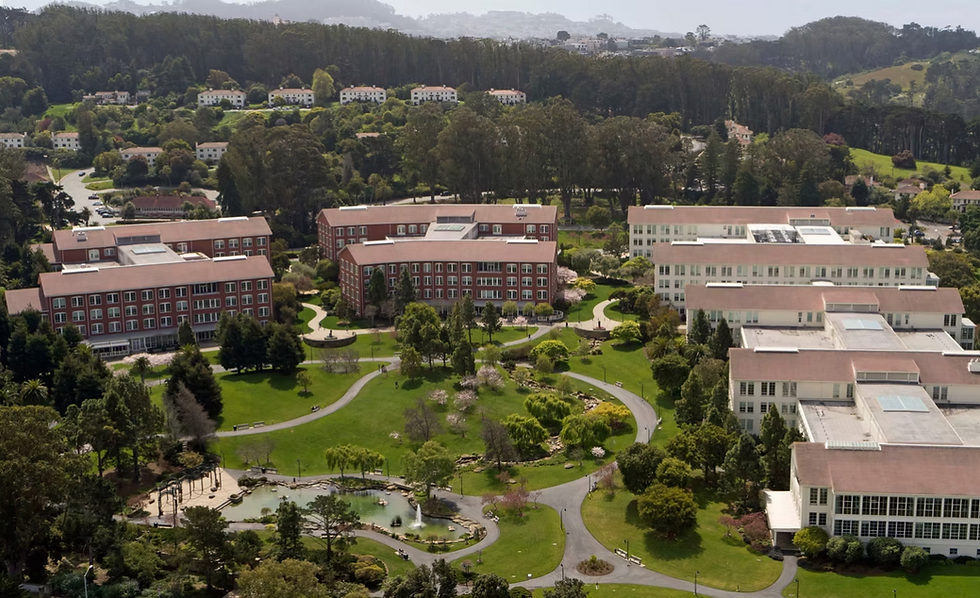
Letterman Digital Arts Center in the Presidio is where ILM is located in San Francisco. This is the site of the former Letterman Army Hospital. The Presidio was established as a military base by Spain in 1776 so it has a long history of dealing with all things military. The hospital opened in 1898 and treated wounded service members through all the major 20th century conflicts before closing.
As part of the deal George made to win the 99 year lease over 3 other companies, he said he would recycle the cement walls and floors of the hospital. So as they demolished the building, they ground up the concrete and there was a massive pile of it on the site that could be remixed and used again. The relevance of this is that the hospital had a history of having ghosts. One of my cousins was in rehab there for a bit after getting shot up during the Vietnam war. I remember when I told him where the new ILM would be located he said "Good luck with that, the whole friggin' place is haunted." I was one of the first folks relocated there in the move from the old ILM site in San Rafael on Kerner and I remember hearing stories from the site guards about seeing lines of soldiers at night near doors that would disappear as they walked over that way to investigate. One of the guards said their theory was, because the new building was being built out of the old material, the folks that had passed away in the hospital still had a connection to it. At one point I showed a graphic layout of the new buildings to my cousin and he said "Brilliant, looks like you put the server room on the site of the old morgue." That seemed to play out as I recall there were all sorts of initial odd problems with the servers there. Although given the years this all happened none of the ghost soldiers would have been deceased IT guys.
The first movie I worked on there was the stereo conversion of "Nightmare Before Christmas." A great movie to work on if there were ghosts wandering around. We were located on the top of A building in that big room right before you got to the sky bridge. The B building interior was still under construction so there were lots of dark hallways even during the day. Dailies were over in the small theaters in B but you could also drop stuff to the Abby (ILM’s media server at the time) just to see it on your own. So there was a bit of wandering around B and any number of folks mentioned they’d seen odd lights or shadowy images down the halls on their way to the theaters.
The Abby's were a bit touchy and as I recall you had to be careful not to overload them. I was working on some shot with Jack Skellington and my composite script was take 13. By some weird cosmic twist the pts (production tracking number) was 00666. I wasn't superstitious, so just dropped the shot to the Abby. I don't know if they ever sorted out exactly why it happened but dropping my shot to the Abby totally crashed it and it took overnight to get it running again.
I'm probably a bit superstitious now. After that I never ran a take 13 of anything. I'd just skip to take 14 and anytime I got 000666 for a pts I wouldn't run it. I would just get 000667. Doing that I never brought the place down again.
Letterman Hospital in its heyday.
Letterman when just ghosts lived there


Letterman Digital Art Center today
(owned by Mellody & George)
Jack Skellington whom I'm sure had nothing to do with the Abby failing

Coming clean after a lot of years.
I’m adding this bit because it was a ghost story from the same time that some folks it remember going round. I sat near Polly Ing when we were working on “Nightmare Before Christmas”.
The thing with Polly and the ghost came up because Mich Chau (President and COO of Lucasfilm at the time) dissed her. Both had gone to Wellesley (although at different times) and Polly had gone back there for some reunion where she ran into Mich. At the reunion Mich was pleasant and they chatted. Polly thinking, she’d made a personal connection like anyone would, running into a coworker (well boss) at a reunion.
A week or so after getting back Polly happened to run into Mich in the hallway. Polly said hi and got absolutely no response from Mich. Kind of like Polly didn’t exist. This happened a couple times and she told me the story which really pissed her off. Word had gotten around that Mich believed in ghosts and was concerned enough that she went around putting up little talismans to ward off evil. Polly and I thought we could use that to get back at her. My cousin told me a number of stories about the “weird shit” that went down and mentioned reading these stories of the ghosts of the Presidio. So we made up this story about this Vietnamese girl whose family had been killed. She fell in love with this Marine and married him and when he was wounded came back with him to the U.S. (and Letterman). Her husband died and shortly after she killed herself. She was the ghost that would show up in the night to comfort wounded soldiers. I supposedly got a Xerox copy from my cousin of a page from a book “The Ghosts of the Presidio” and Polly and I sent it around knowing that it would find its way to Mich. The “copy” was just something I mocked up making it look like a page from an old book and I combined Polly’s staff photo with that of a Vietnamese girl, tweaking it a little to make Polly look a bit more Vietnamese. The hope was that Mich would notice how much the picture (from this 30 year old “book”) looked like Polly and it would freak her out a bit.
Mich definitely saw the page. I got an email asking me to ask my cousin where he got the book from. I eventually wrote back that my cousin said it was out of print and he had put his copy in storage but would look and see if he could find it . . . . . . but he never did.

Twister 1996
I was a CG Digital Compositor on “Twister”. This story is about my claim to infamy. It is a bit tech nerdy to get to the punch line but bear with me. Also it was long ago so if my tech details are slightly off forgive me.
The biggest problem with films that rely on CG visual effects is that if you don’t have working computers you have nothing.
By this time ILM was settling into the various creative disciplines and coming up with GUI’s (graphic user interfaces) or using programs that had interfaces rather than having to code to do anything. But that meant there needed to be a lot of behind the scenes pipeline stuff set up. Show environments (showenv) in particular. This was a pretty new field of expertise for film and not glamorous or client facing at all. These folks wrangled all the incredible amounts of data that only increased over time. As technical as this was, it was basically an entry level job to get your foot in the door at ILM. We had a lot of recent M.I.T. grads in these positions that were probably getting paid less than they paid to go to school the year before. But you really needed to be that smart in a discipline that was new to film making.
There was an effort to allow shows to modify the working environment just for that film. One way was to use what are called dot files which are just text files whose name starts with a “.” like .cshrc In this dot file were lines of code that indicated what show environment to use, what color space to use, how images should be labeled etc. To sort this out fell to the CG Supervisor. This file would then live in everyone’s individual home environment on their work station (the computer they worked on). If there was some update that need to happen this “dot” file would need to be updated.
Now working on your own machine was pretty straight forward. The machine would look at the .cshrc file when it was going to do anything and adjust the various programs for the show you were working on. The problem was when you went to run the whole length of your shot you needed to do that on the network grabbing as many other machines as possible (or allowed). That meant the “other machines” needed to know that I was running a composite for “Twister” rather than “Mission Impossible” for example. So my (and every other person’s) .cshrc file needed to be copied to every other machine when there was an update.
There was a clever program called disdot which did that. You could update your dot files and then you would type
disdot
And that would distribute the appropriate dot files (like my .cshrc file) to all the other machines.
Henry LaBounta was credited as a “Digital Tornado Designer” on “Twister” but I think he was higher up in the pecking order as he nominated for an Oscar and won a BAFTA for “Twister”.
He sent out an email requesting we all update our .cshrc file. I have no recollection of what was put in the email but the structure was something like this.
**********************************************************
Put this in your .cshrc file
# This code updates something on the show
Blah blah doh blah doh doh doh
# Then run
disdot
***********************************************************
I copied and pasted the whole request into my .cshrc file which is not what Henry asked me to do. I was to copy in just the two red lines and then run disdot not add disdot to the dot file.
Dot files get activated by opening up a new window to work in. Until you do that they just sit there. I had no need to open a new window for a few hours as I was working in a compositing program. So for a few hours all was right at ILM.
Then I opened up a new window about 4pm on a Friday, about the time everyone was trying to kick off their shots for the weekend. So opening a new window then accessed my .cshrc file which would automatically run disdot which would then distribute my dot files to all computers which when they received the dot files would see disdot and would then automatically distribute my dot files to all computers ad infinitum. About 120 work stations (plus farm) existed and were getting my dot files and then also distributing my dot files.
Disdot was a very simple program but you run any simple program exponentially on 120 work stations and it will bring down your network which is exactly what I did. At first the calls were polite. “Hey Jon I see you’re running something on my computer. Could you get off so I can kick off my shot for the weekend? “ It didn’t take too long for the politeness to go away and it was “ Hey! Get the fuck off my computer.” Render support jumped in and fairly quickly after talking to me figured out what was happening. The multiple updates to my .cshrc.usr file were going too fast to stop the program. All the pipeline folks could do was shut off all the 120+ computers and then update my .cshrc file which took them a good part of the weekend.
Somewhat before this time a tradition had started that if you mucked up something you and other folks you were working on. You had to buy them donuts the next day. Generally this was your specific working group so maybe 4 or 5 people. I went online and looked at the phone list. At that point there were about 120+ people at ILM so on Monday I brought in 120+ donuts. You would have been thought I would have been shown the door after that but they kept me on. It is my understanding that for years during the “Intro to ILM” classes for new hires this incident was brought up as a warning. Over the years different folks missteps did some variation on bringing the place down but I hold some perverse pride in that nobody has ever done it with fewer keystrokes. I did it with just 6 for disdot.
Needless to say, after this, how dot files were distributed was changed.
*************************
Everyone is familiar with the flying cow in “Twister”. There was an earlier scene when the barn explodes. Someone painted Jan Debont’s name, in the style of the “Chew Mail Pouch Tobacco” ad you used to see on barns, on one of the CG pieces of the barn that flies through the air. We all thought that was pretty clever as it was only there for a second. I heard Jan did not agree and it seems to have been taken out.
I think this is that scene.
This is the flying cow.


*********************************
I don’t know the specifics because I was just one of the worker bees on “Twister” but word in the hallway was that the director, Jan Debont, was a difficult client. I also have no idea how specifically involved George was with the running of ILM at that point other than getting reports. Again word in the hallway was that George was not happy with the way Jan was treating us, especially because of how phenomenal the work was. George came to the “Twister” wrap party and Jan was there as well. I had gotten to know George a bit when I worked on the MC Printer because it was a bit of a technical marvel at the time and George would occasionally bring someone around to show it off. So I was pretty comfortable going up to say hi, which I did with Rosie. Jan had wandered over within the eye line of George and seemed to be waiting for a moment to engage him and perhaps make amends for how he treated ILM. I think George noticed him but seemed to make an effort to get really engaged talking to Rosie. I had stepped away and watched from the side as George just kept talking with her and kind of put Jan in his place until Jan wandered away. So Rosie for the win putting Jan in his place.
Pirates of the Caribbean : On Stranger Tides 2011
Most of our work is industrial or light based but sometimes out of nowhere there is magic. Okay that was a bit over the top but this one you wouldn’t believe if it was in a movie.
I was the composite supervisor on “Pirates of the Caribbean: On Stranger Tides”. Our biggest challenge was the mermaids. Rob Marshall, the director, had chosen Astrid Bergès-Frisbey to be the principal mermaid Syrena, a bunch of super model looking woman were to be the mermaids whose face and upper bodies we would see, and then a bunch of stunt women to do the more physically challenging bits whose performances were copied by the animators so we could replace them completely. The problem was all the actors had legs, not a tail fin so every mermaid needed some CG and on a good number, the CG tail was blended on to the actors at their torso and chest. A lot of Syrena’s shots were like that.
There was one series of shots where Serena was being carried in a water filled coffin. She needed to look scared. Astrid was not in the coffin as she would have had to be under water the whole time and a water filled coffin would be too heavy for the actors to carry. So we used a CG version with the idea that if need be we could just do a face replacement. Dean Yurke was doing the comp and it soon became apparent that the CG face wasn’t going to work. Filming had wrapped so we couldn’t just ask them to do a pickup for us. By this point all the actors had gone on to their next project or gone back home, Astrid we assumed to Paris.
One evening Dean came to my office in the Pirates production suite. We were talking about what other shots or takes we might be able to use for the face replacement but nothing was great. This wasn’t that important a scene so the producers wouldn’t be willing to cough up more money. We knew we just had to use what we could find. A pickup wouldn’t take long and we wished we had Astrid but that ship had sailed.
Most folks had gone home so it was pretty quiet. Most of the lights were off except in the conference room right across from me. We heard a couple folks walk into the production suite and one stood in my door kind of shadowed from the front but somewhat dramatically (accidentally) rim lite by the conference room light. She said in with a slight French accent, “Hi, I’m looking for Ryan Wiedekehr. Do you know where he might be?” It was Astrid.
I know this sounds made up but it was certainly magical and absolutely true. Dean and Ryan can vouch for it. Astrid was in the middle of a promotional tour for a French movie she had starred in that was just being released. “The Well-Digger’s Daughter”. She and her boyfriend had some time off and decided to drive up from Los Angeles to San Francisco as they had never been to California and wanted to visit Ryan who was the on set VFX production manager for “On Stranger Tides”. They had become friends on the challenging shoot.
Dean and I talked with Ben Show ( VFX Supervisor), Susan Greenhow ( VFX producer), Ryan and Astrid to see if there was any possible way to do a quick shoot down on the motion capture stage to get a better head shot. Magically they all made it happen. Astrid was a warm generous person taking a bit of time out of her vacation to help us out. Ben supervised it the next morning and we got what we needed. The final cut is shorter than what the shot was originally but we got a good take. George didn’t sell Lucasfilm to Disney till the next year so this wasn’t one of those “When you wish upon a star . . .” Disney things. This was good old Industrial Light’s magic.
This is Astrid . . . okay not on the day but this was what she looked like when we first saw her.
This is a still of the water coffin with Syrena


This is part of the sequence of Syrena in the water coffin. I extended the cut to include Penélope Cruz and the snake because who doesn’t like Penélope Cruz and the snake is CG.

Noah 2014
Darren Aronofsky is one of my favorite directors to work with for a bunch of reasons. One of those is how he interacts with the crew. Especially those of us that are the “great unwashed”. Meaning we are below the line, doing the actual work not making decisions about what work there is to do. There is definitely a hierarchy in film with (in general) the director at the top. (The caveat is whomever controls the money is really at the top.) As far as dealing with ILM, the director pretty much just interacts with the Visual Effects Supervisor. The better VFX Supes will include the various discipline supervisors in as many of the meetings as possible so they can hear the director’s requests first hand and not rely on notes being passed down.
Darren is based in New York but visited ILM a number of times. Ben Snow was the VFX Supe and included his leads in most of the meetings. I was the Composite Supervisor on “Noah” so was part of those. Darren is really personable and easy to chat with. Somehow the fact that I had 4 sons came up and Darren would chat a bit about his son Henry (who was about 8) with me. The only time Darren would interrupt our production meetings was to take a phone when Rachel would call to sort out something about their son, like could Darren get him to school the day after he got back. I loved that he was such a hands on Dad. I guess I just assumed he had a phalanx of nannies to deal with the day to day stuff. Some of the directors I’ve dealt with over the years were pretty full of themselves but Darren just seems like a regular guy that happens to direct movies for a living.
I had a group of compositors that were exceptional. One of the best of the exceptional was Cristin Pescosolido. An incredible artist and one of the smartest people I’ve ever met. And by an odd coincidence had been at Harvard with Darren. Darren made a point of stopping by her desk when he came for meetings just to chat with an old friend like a regular guy that just happens to direct movies for a living. Cristin has a big personality and just because Darren had gone on from college to make some films Cristin wasn’t going to give him any slack. My impression of their relationship was kind of like a brother and sister which was pretty humorous at times.
I was never shy about giving Cristin the toughest tasks because if there was anyone who could sort them out it was her. “Noah” was a real mix of plates shot with practical effects and tons of CG characters and FX added after the fact. Cristin had one of the fight sequence shots that takes part in the rain. Obviously “Noah” at a certain point in the film would have a lot of rain. We had some practical rain but also added some CG rain from the FX department but Cristin was also using Nuke’s (composite software) particle system to fill in the gaps. At one of the dailies she presented it to Darren and it was pretty far along. This is a clip of her long incredible shot.

Darren had some minor notes and gave them in little bit of a grumpy brother way. Cristin not backing down at all said in a sarcastic sister way, “ I know tomorrow is your birthday. Anything else I can get you?” He said, “Yeah I’d love a pony.”
Sadly I don’t have a clip of Cristin’s next take, just the frame below on the right. For this take Cristin had used Nuke’s particle system to make the shot rain ponies. That made Darren happy but sadly he didn’t use that version in the film.
shot with just rain
shot with ponies
